
Published ranges by flat type
Qanvast published its 2026 projections in February 2026, built from 2025 medians across 449 resale projects and 341 BTO projects on its platform, with 1 to 2 percent inflation applied.
| Flat type | Resale HDB (S$) | BTO for comparison (S$) |
|---|---|---|
| 3-room | 55,000 to 68,300 | 40,800 to 52,500 |
| 4-room | 70,000 to 81,600 | 50,000 to 60,000 |
| 5-room | 80,800 to 98,900 | 60,600 to 76,500 |
These are medians of what homeowners actually spent, not quotes. A lighter-touch resale job can land below the range; a full strip-out with new bathrooms, rewiring and a carpentry package throughout can land above it. Treat the table as a planning band, not a price list.
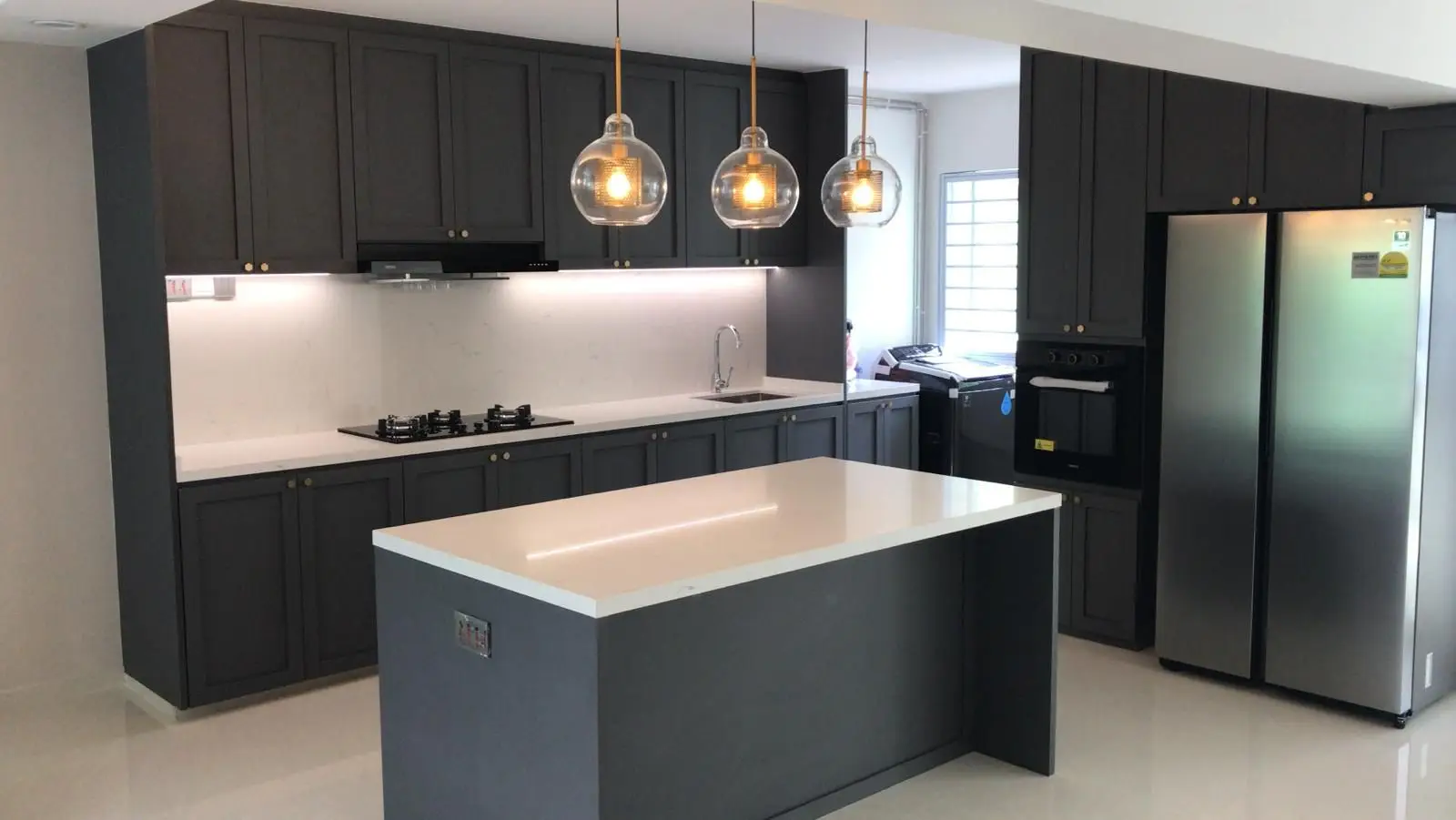
See our HDB renovation with full carpentry, Blk 93A Telok Blangah →
Why resale costs more than BTO
- Demolition before anything else. Old tiles, cabinets, built-ins and ceilings have to come out and be carted down. BTO flats skip this entirely.
- Rectification you cannot see on viewing day. Decades-old wiring, corroded pipes, hollow tiles and failed bathroom waterproofing all surface once hacking starts. Budget a contingency; most guides suggest 10 to 20 percent.
- Full bathrooms, not partial. Resale bathrooms usually get hacked to the screed, re-waterproofed and re-tiled. That is the single most labour-heavy room in the flat.
- Rewiring. Flats from the 1980s and 1990s often need a new distribution board and new circuits to carry today’s appliances and air-conditioning.
- Layout changes. Removing a non-structural wall, enlarging a kitchen entrance or converting to an open kitchen adds hacking, making-good and permit scope.
Where the money goes
Qanvast’s 2026 budgeting survey of 300 homeowners found carpentry was the largest single share of renovation spend. In a resale flat the typical order of cost, highest first, is: carpentry; wet works (hacking, masonry and tiling); electrical and plumbing; ceiling and painting; doors, windows and grilles; then fittings and sanitary ware. Carpentry leads because it is both the most visible part of the home and the most customised. It is also the part we make ourselves, which is why our quotations itemise it piece by piece rather than as a lump sum.
What moves your number
- Overlay or hack. Overlaying new tiles or vinyl over a sound existing floor avoids hacking, disposal and screeding. Hacking is needed when the floor is hollow, uneven, or the level must change. See our overlay vs hacking guide.
- Number of bathrooms fully redone. Each full bathroom is a project in itself.
- Carpentry footage and finish. Full-height wardrobes, a kitchen with tall units, and curved or fluted fronts add cost. Straight lines and standard laminates keep it down.
- Kitchen layout. Keeping the sink and hob positions avoids rerouting plumbing and gas.
- Ceiling. A full false ceiling with cove lighting costs more than a cornice and downlights.
- Materials. Porcelain versus homogeneous tiles, laminate versus veneer, quartz versus solid surface. The differences compound across the flat.
How we quote
We do not quote resale flats over the phone. We visit, measure, open a few things, and send an itemised quotation with every line priced and a works schedule. Every renovation in an HDB flat must be carried out by a contractor listed in HDB’s Directory of Renovation Contractors; Innovation Workshop is listed as HB-01-3459G, and we apply for the renovation permit on your behalf.